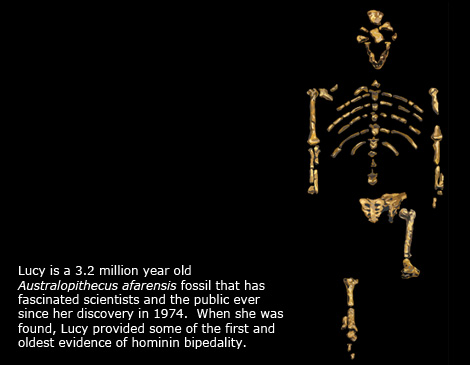

Arguably the most famous fossil hominin, Lucy is 3.2 million years old and considered by many to be a close relative of humans. Her species, Australopithecus afarensis, is now extinct, but we are able to learn much about her species and how she might be related to humans through the examination of her fossilized skeletal fragments.
She was found in 1974 by a team of French and American antrhopologists at the Hadar Site in Ethiopia. About 40% of Lucy's skeleton was recovered, an astonishing feat for a fossil so old. Beginning on August 31, 2007, Lucy began her first public tour of the United States and can be viewed in the exhibit, "Lucy's Legacy: the Treasures of Ethiopia" at The Houston Museum of Natural Science.
is a product of the Digital Imaging Lab at the University of Texas at Austin. The projects are part of the Virtual Skeletons Project, which is funded by the UT ITS. This site makes use of several technologies that require browswer plugins. Before you start you should visit the plugins page to ensure that you have the proper plugins to take full advantage of this site.
The eFossils project will integrate the various lines of evidence for human evolution - such as geologic age and context, paleoecology, fossil specimens, and archaeology - into a single database. An interactive timeline will allow users to navigate through human evolution. Virtual specimens, presented in 2-D and 3-D, will enable users to view and explore hominin fossils.
|
Faculty Content Contributors: Principal Investigator: John Kappelman, PhD Project Manager (current): Lauri McInnis Thompson, PhD Programming: Stuart Ross Current Contributors: Adrienne Witzel |
LAITS Production Credits: Project Producer: Joe TenBarge, Assistant Dean Project Manager and Programmer: Peter Keane Art Direction, Graphic Page Layout & Logo Design: Suloni Robertson Illustrators: Marissa Kopatic, Julio Garcia, Lindsay Jones |